
How Ambulance Service Works in India: Types, Crew, Equipment and Costs Explained
How Ambulance Service Works in India: Types, Crew, Equipment and Costs Explained
Written by the ICU Ambulance Service Lucknow team | Updated: October 2026
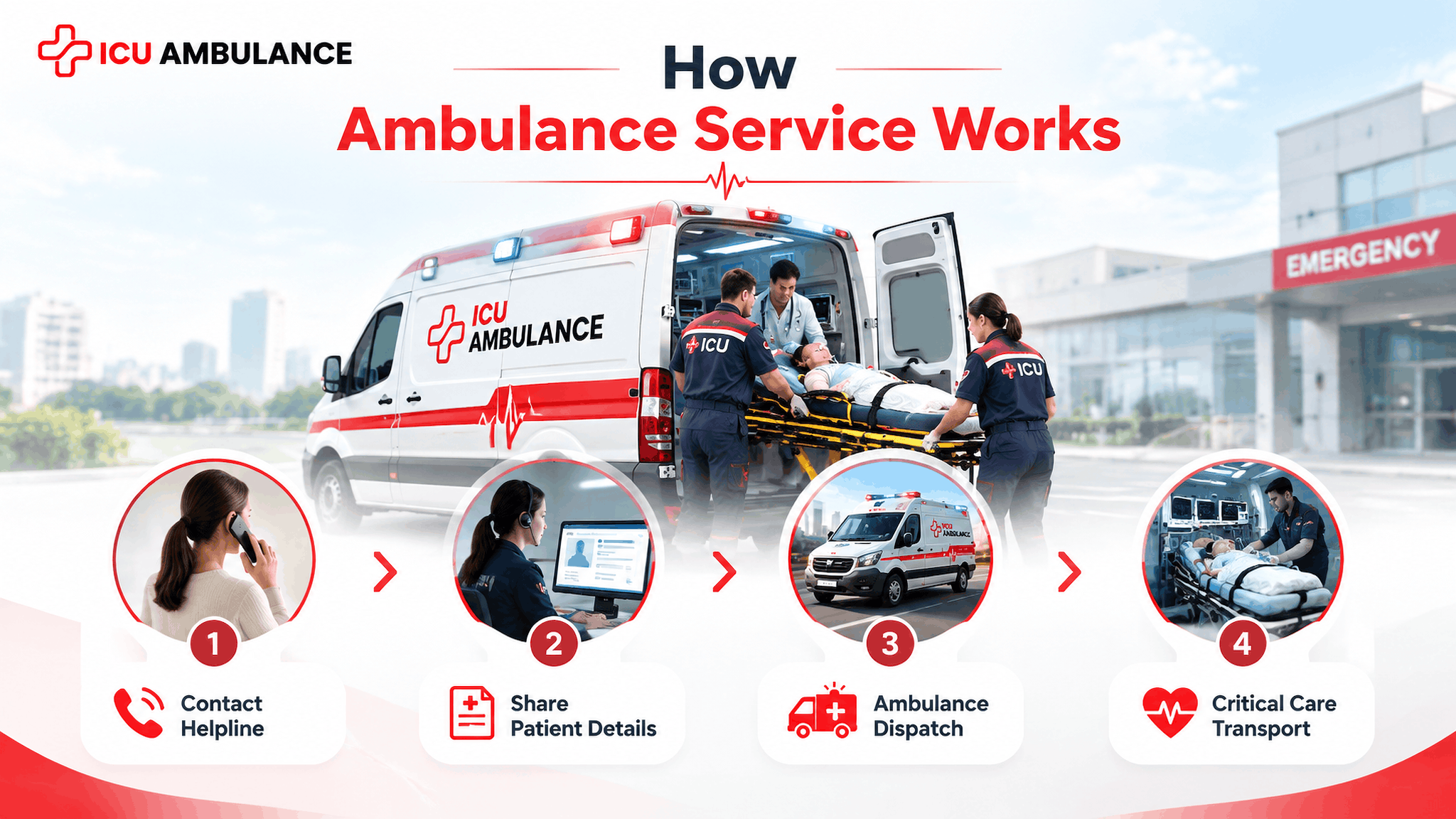
Quick answer: How ambulance service works in India comes down to one organised system with a control room, trained crew, medically equipped vehicle, and a receiving hospital. A call comes in to the control room, the nearest appropriate ambulance is sent, care starts on the way, and the patient is passed on at the hospital. Government 108 service is free for patients. Private services are paid.
Most people think of an ambulance as nothing more than a vehicle that transports a patient to the hospital. In fact, it is a complete system, and knowing how ambulance service works helps you to choose.
In this guide, we explain the siren system — who runs ambulance services in India, the different types of ambulance, who is inside, how charges are decided, and how a planned transfer differs from an emergency. Read our separate guide on what happens when you call an emergency ambulance for the step-by-step flow after you dial a number.
How Ambulance Service Works: The 5 Parts of the System
Five parts that need to work together to understand how the ambulance service works:
-
Control room: Takes the call, confirms location, and decides which ambulance to send.
-
Fleet: Different kinds of ambulances ready in different locations.
-
Crew: Driver, EMT, paramedic, and a nurse or doctor in critical situations.
-
Equipment: Oxygen, monitor, and suction in each vehicle; ventilator and defibrillator in ICU units.
-
Hospital link: The receiving hospital is notified and assumes care.
Key Facts About How Ambulance Service Works in India
-
India has a single emergency number, 112, under the Emergency Response Support System (ERSS). The official 112 India website says it integrates police (100), fire (101), ambulance (108), and the women and child helpline (181) under a single number, which can be contacted through call, SMS, email, SOS, or the 112 India app.
-
108 and 102 are different. Under the National Health Mission, 108 is for emergencies like trauma, accidents, and critical illness, while 102 is basic patient transport, mainly for pregnant women and children. Factly reports data from NHM that shows 33 states and UTs provide 108 or 102.
-
WHO benchmark: one emergency response ambulance for every 1 lakh people in plain areas, also mentioned by 108 operator EMRI.
-
Why speed matters: In 2018, India recorded 151,417 road deaths, or about 17 per hour (IndiaSpend, October 2023). The first hour after trauma is termed the golden hour. Good Samaritan and golden hour treatment have provisions in the Motor Vehicles (Amendment) Act 2019.
Who Runs Ambulance Services in India?
There is no single owner, so how ambulance service works depends on who runs the vehicle:
-
Government ambulance (108 and 102): Operated by state health departments, often through contracted operators. Free to the patient.
-
Private ambulance companies: You can book directly, 24 hours a day, 7 days a week, and they usually have more options, such as an ICU ambulance or a ventilator ambulance.
-
Ambulances owned by the hospital: Primarily used to transport that hospital’s own patients.
-
Ambulances of NGO and trusts: Some are free or low-priced but less in number.
Types of Ambulances and What Each One Does
India has an official ambulance code - AIS-125 - approved by the Ministry of Road Transport and Highways. It establishes minimum standards for the construction and equipping of an ambulance and covers categories such as first responder vehicles, patient transport, basic life support, and advanced life support. In day-to-day practice, families usually ask about these types:
|
Ambulance type |
Best for |
What it usually has |
|
Patient transport |
Stable patients going for tests, discharge, or a planned shift |
Stretcher, oxygen, basic first aid |
|
BLS ambulance |
Patients who need oxygen and basic monitoring |
Oxygen, suction, pulse oximeter, trained EMT |
|
ALS / ICU ambulance |
Critical patients: heart attack, stroke, serious accident |
Ventilator, defibrillator, cardiac monitor, infusion pumps, emergency medicines |
|
Ventilator ambulance |
Patients already on ventilator support |
Transport ventilator, monitor, oxygen supply |
Not sure which one fits? Read emergency vs ICU vs basic ambulance, or see what a BLS ambulance carries and the equipment an ICU ambulance should have.
Who Is Inside the Ambulance?
The type of ambulance depends on the crew. This is an important part of how ambulance service works in practice.
-
Driver: trained in Emergency driving and basic first aid.
-
EMT (Emergency Medical Technician): Oxygen, control of bleeding, splinting, and patient handling.
-
Paramedic: Monitors vital signs, runs the ECG, starts IV lines, and administers emergency medicines under protocol.
-
Nurse or doctor: Usually available for transfers to ICU and ventilators.
The paramedic role in the ambulance can be seen. Before booking, ask who will be travelling with your patient and what training they have.
How Ambulance Service Works Behind the Scenes
Much of the work is done before the phone rings. The routine at ICU Ambulance Service Lucknow, which has been serving patients since 2004, is as follows:
-
Vehicle readiness: Check oxygen cylinders, monitor batteries, suction units, and fuel at the start of each shift.
-
Cleaning: The stretcher and equipment are disinfected after each trip.
-
Hospital Coordination: For transfers to the ICU, the team confirms bed availability with the receiving hospital before the vehicle departs.
-
Record keeping: Clear handover is ensured by noting vitals, medicines given, and the patient’s condition.
How ambulance service works is reliable on the road because of good preparation.
Emergency Ambulance vs Planned Patient Transfer
In practice, how ambulance service works for planned trips is quite different from emergencies, and a large share of trips are planned.
Emergency trips are urgent. The patient is taken to the nearest appropriate hospital, and time is critical.
The transfer of patients planned includes transfer from one hospital to another, discharge to home with oxygen, travel for dialysis or chemotherapy, outstation travel such as Lucknow to Delhi or Patna by road. Here you have time to prepare: ask the doctor treating you which type of ambulance you need, take all your reports with you, make sure there is a bed at the hospital where you are going, and agree on the route and the total cost before the vehicle starts. See our guides to road ambulance and critical care ambulance transfer.
How Are Ambulance Charges Decided?
Government ambulances under 108 are free for the patient. There’s no single rate for private ambulances across India. Final ambulance charges are usually based on:
-
Type of ambulance: An ICU or ventilator ambulance is more expensive than a basic ambulance.
-
Distance: Most services charge by the kilometre or by the trip.
-
Medical staff and equipment: Cost goes up if there is a paramedic, nurse, or doctor on board.
-
Waiting and return time: You may be charged for waiting at the hospital or for returning empty.
-
Tolls, parking, night hours: Check if those are included.
Then ask for the total estimate and what it includes. Go through our guide on ambulance charges and the cost of ICU ambulance service in Lucknow.
Government vs Private Ambulance: Which One Should You Choose?
|
Point |
Government (108/102) |
Private ambulance |
|
Cost |
Free |
Paid, depends on type and distance |
|
Availability |
Depends on demand in your area |
Can be booked directly, 24x7 |
|
Equipment |
Usually basic life support; some advanced vehicles |
Basic, ICU, and ventilator options |
|
Hospital choice |
Usually nearest government hospital |
Family can choose the hospital |
|
Planned transfers |
Limited |
Available, including outstation |
Both have a role to play, and knowing how ambulance service works in each case makes the choice easier. If there is no other immediate option, in a life-threatening situation, call 112 or 108 immediately. Do not wait for a certain service while the patient’s condition is deteriorating. In cases where a patient needs ICU-level care en route, or the transfer is planned, a private ambulance is often the practical choice. Read more about private ambulance vs government ambulance in Lucknow and 108 vs 102 ambulance service. Keep this booking info checklist handy.
Frequently Asked Questions
How does an ambulance service work?
The call goes to a control room, the nearest suitable ambulance is sent out, a trained crew treats the patient on the way, and the patient is transferred to an informed hospital. Private services also include long-distance and planned transfers.
Which number should I call for an ambulance in India?
Dial 112, the single emergency number of India, or 108, the emergency ambulance number in most of the states. Both are free to call. For a planned transfer or for ICU-level care, you can arrange a private ambulance directly.
Is ambulance service free in India?
108 & 102 are free government services for the patient. Private ambulances charge by type, distance, and medical support.
What is the difference between 108 and 102?
108 is an emergency service for accidents, critical illness, and trauma. 102 is basic patient transport, mainly for pregnant women and children, e.g., delivery or newborn care trips.
What is the difference between a BLS and an ALS ambulance?
BLS ambulance provides basic care such as oxygen and basic monitoring. An ALS ambulance, or ICU ambulance, carries a trained paramedic, nurse, or doctor for critical patients and has a ventilator, defibrillator, and cardiac monitor.
What is the golden hour in emergency care?
The golden hour is the first hour following a serious injury. Early first aid and prompt hospital transport during this period increase the chances of survival.
Medical disclaimer: This article is not medical advice and is for general information only. In case of any medical emergency, call 112 or 108 or the nearest hospital immediately.
Need Help Choosing the Right Ambulance? Talk to Us Now
If you are not sure about the type of ambulance your patient needs, our team at ICU Ambulance Service Lucknow can tell you how ambulance service works for your case and guide you within a few minutes. Get a clear answer and a transparent quote on +91 7880310444 or contact us on our contact page. You can also check our home page for all available services and ICU ambulance services in Lucknow.