
Private Ambulance vs Government Ambulance in Lucknow: What Is the Difference?
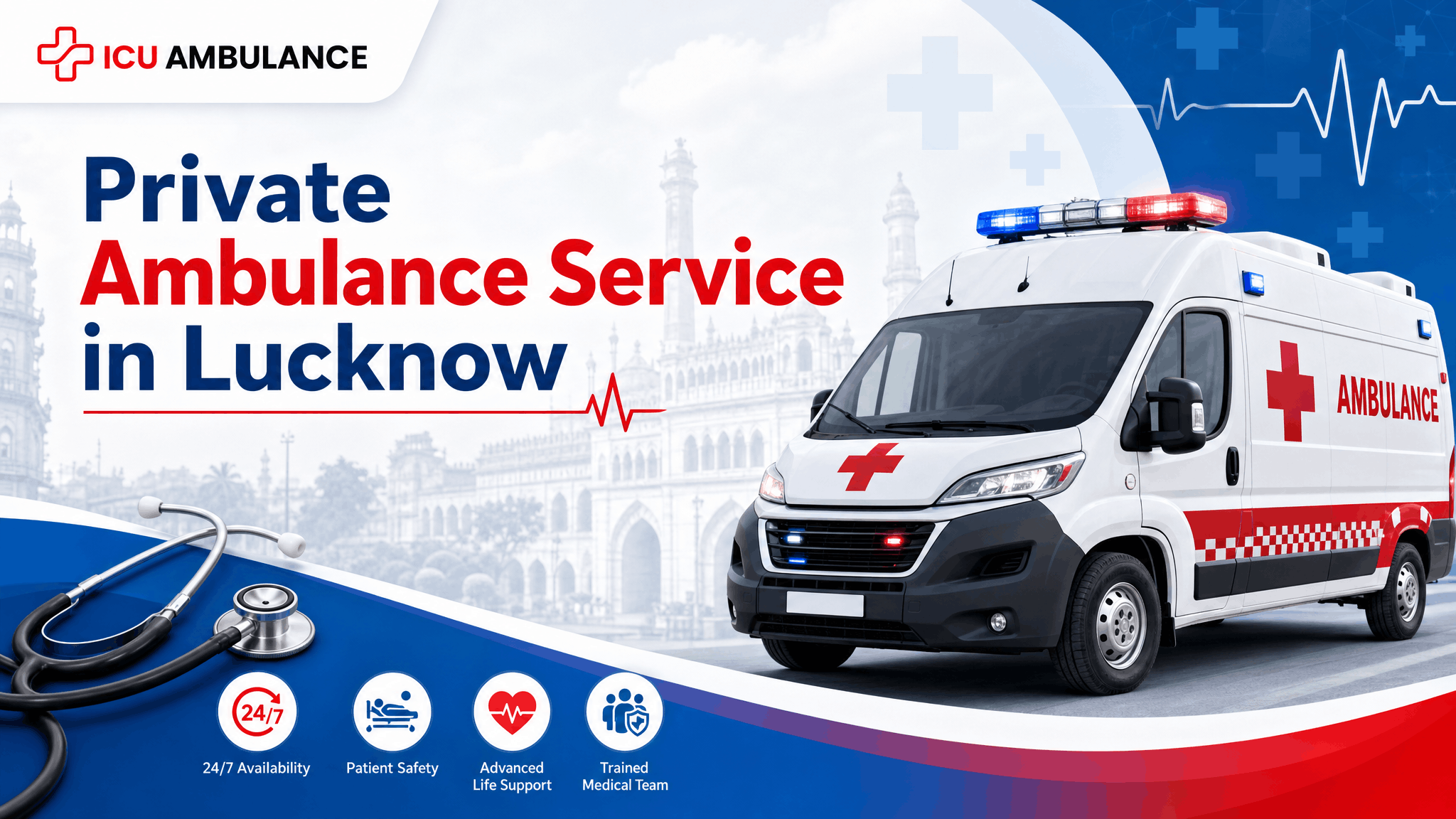
Private Ambulance vs Government Ambulance in Lucknow: What Is the Difference?
When moving a patient, selecting the proper ambulance is crucial. In Lucknow, patients and families have government and private ambulance services to choose from. There are differences in accessibility, equipment, response times, level of comfort, and the types of patient transportation that each offers.
Informing yourself about the differences can help families make informed decisions, especially when a patient needs to travel to the hospital or requires medical support on the move.
For private ambulance services in Lucknow, families should be aware of private ambulance services and when using a private ambulance is more convenient than a government ambulance.
What Is a Government Ambulance?
A government ambulance is a vehicle sent to transport patients by a government health service. They serve to cater to patients who are unable to afford transportation and transport patients, primarily in emergencies.
Examples of times when government ambulance services may be relied upon are:
- When there is a need for emergency transportation.
- When patients need transport to a government hospital.
- When there is a roadside medical emergency.
- For basic patient transfer.
- For supportive services to government health care facilities
The service may differ in the type of ambulance, staff, and equipment deployed depending on the location and the severity of the situation.
For a case of a patient in a stable condition who requires a straightforward transfer, a government ambulance may be used where it is available.
What Is a Private Ambulance Service?
A private ambulance service offers transport to a private health care or ambulance provider. This service is normally reserved with a direct call to the provider or over their preferred booking platform.
A Private Ambulance Service in Lucknow may have various types of ambulances for patrons based on the nature of their medical needs. Based on the provider, choices may include a BLS ambulance, ALS ambulance, ICU ambulance, ventilator ambulance, oxygen ambulance, or other extra amenity-specific vehicles.
ICU Ambulances provide patient transport in different configurations of medical or transport requests.
Private Services can be extremely useful on occasions where a family requires a custom transfer of an ambulance, transport to/from hospital, medical assistance during travel, or scheduled transportation.
Private Ambulance vs Government Ambulance: Key Differences
The main difference is not simply whether the ambulance is government or private. The more important question is whether the ambulance available matches the patient's medical needs.
|
Factor |
Government Ambulance |
Private Ambulance |
|
Availability |
Depends on public ambulance network and demand |
Can often be booked directly |
|
Cost |
Often subsidised or lower-cost |
Charges depend on service and distance |
|
Ambulance Types |
Usually based on available fleet |
Multiple categories may be available |
|
Medical Equipment |
Depends on ambulance type |
Depends on selected ambulance |
|
Hospital Transfer |
May be possible depending on availability |
Commonly arranged as a dedicated service |
|
Scheduled Booking |
May have limitations |
Often more flexible |
|
Choice of Vehicle |
Limited to available units |
More options may be available |
|
Specialised Support |
Depends on available resources |
Can be requested according to patient needs |
These points can help families understand why one option may be more practical than another in a particular situation.
1. Availability and Response Time
When you think about the first responders for a family emergency, parents are naturally concerned about availability.
Government ambulance services may not be immediately available when responding to a lot of calls.
Private ambulance services give families a potentially faster alternative since a family can directly call a private service to bring an ambulance to them.
However, it is important to note that in almost all cases, response times cannot be guaranteed because it depends on a variety of factors such as current location, traffic, distance, how many other calls are currently being responded to, the state of the roads in the area, and more.
It is always better to ask for an approximate time of arrival instead of assuming "fast service" will get the family a faster response.
2. Choice of Ambulance Type
Government services may offer different options when it comes to ambulances. However, they are limited to what is currently available in their local fleet and what demand may currently be.
Private Ambulance Services in Lucknow give the option to family members to select as per the patient's need.
- BLS Ambulances are adequate for patients who need a basic level of medical intervention and support during the transport.
- ALS Ambulances can be utilized for patients transporting patients in need of advanced care during transport.
- ICU Ambulances are designed for patients requiring intensive care during transport.
These Ambulances can be used for patients who need mechanical ventilation support.
During transport, if patients need support, then an appropriate Ambulance can be chosen based on the patient’s medical condition and the advice of the treating physician.
3. Medical Equipment
Consideration of equipment used in ambulances is also essential.
Basic ambulances will include the necessary equipment for patient transport and may include something like an oxygen supply. More advanced ambulances will include monitoring equipment, suction, emergency drugs, IV equipment, medicines, and ventilators.
Not all private or governmental ambulances will have the same equipment.
Therefore, prior to booking, one should ask a simple but important question...
"What medical equipment does this ambulance have?"
For some critical patients, the equipment may be more important than whether the ambulance is private or governmental.
4. Medical Staff During Transportation
Service contracts impact the movement of patients with medical personnel.
Most ambulance services require families to inform them of the patient's serious medical conditions during booking. This helps the supplier to determine whether basic transport or advanced medical support is required.
For instance, transporting a patient requiring ventilator support in a basic transport unit is improper.
5. Hospital-to-Hospital Transfers
Hospital transfers in Lucknow happen for various purposes; patients have to move from one hospital to another for consultations, surgery, ICU admissions, diagnostic services, or continued treatment. Sometimes, government ambulances are capable of helping with transfers if they are available and if the operating arrangements align with the situation.
Private ambulance services are preferred over government services for planned hospital transfers because the family can hire the private ambulance and arrange the transfer according to their convenience.
Families should keep hospital arrangements for admission and/or the treatment ready and then arrange for a non-emergency transfer.
6. Cost of Ambulance Service
Price plays a huge role with Indian families.
Some government ambulances are free or low-cost under certain schemes with some limitations. Eligibility criteria and availability are unknown.
Private ambulances generally have multiple factors that determine cost:
- Type of Ambulance
- Distance
- Location
- Equipment provided
- Staff provided
- Wait time
- Special requests
- Transport across city or state
Be sure to ask what the overall cost with all the inclusions will be.
There are a lot of factors other than the cost that entail whether the patient has specialized medical needs.
7. Comfort and Patient Handling
Patient Confort
Different private ambulance companies may have different vehicles available in their fleet. Families should be able to find out about stretchers, patient transport position, availability of oxygen, and space for accompanists and other logistical considerations.
For elderly, injured, or critically ill patients, handling during loading, transport, and unloading has to be done with special care.
When Should You Choose a Private Ambulance?
If the following examples apply to your situation, a private ambulance may be the better option over a government ambulance:
- If you need a specific type of ambulance.
- If you need transport for a patient with advanced medical needs and oxygen.
- For hospital-to-hospital transport.
- If transport for a scheduled transfer is needed.
- If the only option is a private ambulance.
- If transport for a critical patient is needed.
Transport for a patient who is long-distance or intercity.
Note. If these reasons do not describe your situation, convenience is not a valid reason for using a private ambulance. If you fall under the examples listed, the medical needs of the patient should take precedence.
When Can a Government Ambulance Be a Good Option?
Government ambulances can be used for emergencies when:
Time is of the essence, and transportation is required.
When the government option for an ambulance is more cost-effective and convenient.
When basic transportation is required.
The provided ambulance carries the necessary equipment for the patient’s condition.
In emergency situations, families should worry more about obtaining medical care than about evaluating multiple options.
How to Choose the Right Ambulance in Lucknow
Before you book with us, keep these things in mind:
1. Understand the Patient's Condition
Find out if the patient needs basic support, oxygen, advanced monitoring, ICU care, or support on a ventilator from the attending physician or the hospital.
2. Select the Appropriate Ambulance
Don’t book the first or cheapest ambulance. Select the right care based on the patient's needs.
3. Confirm Equipment
Find out if the required oxygen, monitors, ventilators, suction machines, and other equipment are available.
4. Confirm Medical Staff
Find out if the patient will have trained medical staff to accompany them if they are unstable and critically ill.
5. Confirm the Route and Destination
Provide the hospital name, the correct destination address, and any special instructions.
6. Ask About Charges
Find out the approximate cost of the transportation, if any, for the additional equipment and staff for private ambulance transportation.
Final Thoughts
There are both public and private sectors for patient transport. Public transport offers an emergency transport option for those with access to subsidized or government-funded health services. Transport by the private sector may be preferred by families in situations where specified ambulances, transported with particular instruments, scheduled or hospital-to-hospital transfers, are needed.
The appropriate option for transport is determined by circumstances such as the state of the patient, time sensitivity, need for medical assistance during transport, cost, distance, transport availability, etc.
When considering patient transport, the needs of the patient must be communicated to the concerned hospital to select an appropriate transport that can safely fulfill the transport requirements.
Choose the Right Ambulance for Patient Transfer
Need an ambulance for hospital transport or any medical transport in Lucknow? ICU Ambulance helps to determine the category of ambulance best suited for patient transport.
Confirm the medical support that you require along with booking the right ambulance for patient transport.