
What Medical Equipment Should an ICU Ambulance Have? Complete Guide
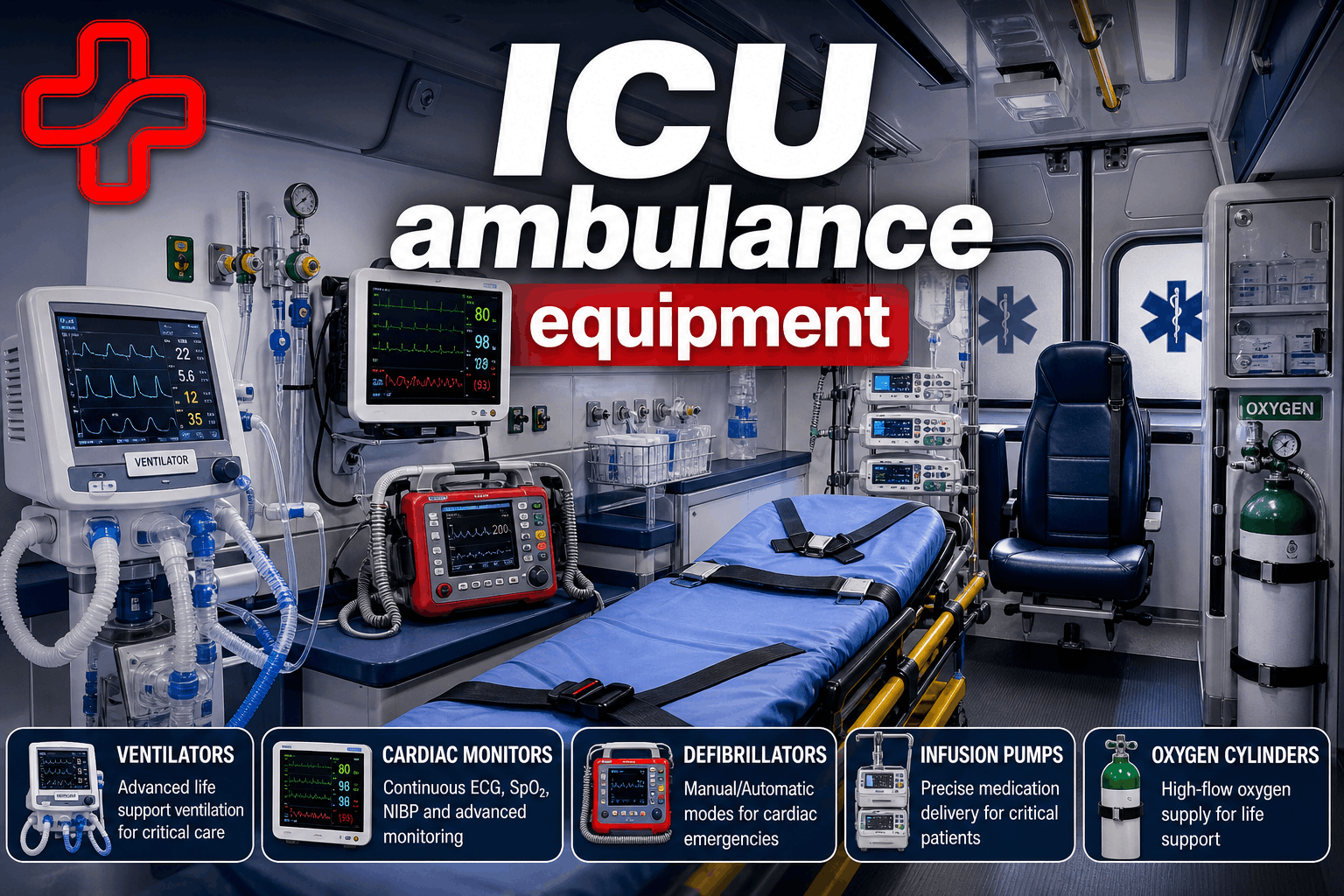
What Medical Equipment Should an ICU Ambulance Have? Complete Guide
An intensive care unit (ICU) ambulance is necessary when a critically ill patient requires a hospital transfer or emergency care during transport. An ambulance with ICU capabilities is equipped with advanced life support systems. Unlike standard ambulances, ICU ambulances are equipped with systems to help sustain a patient’s condition during the transfer. When transport time is the most critical, the quality and presence of ICU ambulance systems are of the utmost importance.
Modern systems found in ICU ambulances are designed to sustain the most advanced forms of critical care. This equipment is also designed to perform critical care and emergency interventions that are needed during a patient transport. Having the proper equipment in a support ambulance, critical care ambulance, and emergency ambulance enables the medical staff to make the necessary interventions to treat the patient if their condition changes for the worse during transport.
In this section, you will learn the most essential equipment that is needed in an ICU ambulance. You will see the support that each system provides to the patient and why it is important to choose a medical transport ambulance that has a high level of ICU ambulance systems.
What Is an ICU Ambulance?
ICU ambulances are specially designed to deliver patients from one hospital to another when the patient is too critical to be delivered without medical support. ICU ambulances deliver medical staff and equipment to the patient.
They are equipped with the standard medical equipment necessary to stabilize critically ill patients. This includes portable medical equipment that an ICU unit would have, such as a portable ventilator, cardiac monitors, defibrillators, and intravenous support equipment.
This type of ambulance is for patients who are:
- experiencing a medical emergency, such as a heart attack, or an emergency that would result in respiratory failure
- involved in a major accident that would severely injure the patient
- experiencing a medical emergency, such as a stroke, that would result in brain injury
- experiencing multi-organ failure
- ventilator dependent
- in need of an inter-hospital transfer
The goal of an ICU ambulance is to transport patients while providing care at the level of a hospital until they arrive at the hospital of their destination.
Why Is ICU Ambulance Equipment Essential During Patient Transport?
In the case of emergency transportation, patients can be at even more of a risk due to the potential for their medical conditions to worsen. A ride to a medical facility can be deadly without the proper equipment in an ICU ambulance. Sophisticated medical technology is able to help staff to assess and treat patients on the go by tracking vitals in real time.
The benefits of fully outfitting an ambulance with ICU-level equipment and devices are many and include:
Continuous Patient Monitoring
Continuous patient monitoring equipment can assess a patient's heart rate, breathing rate, and other vitals. If transport staff are able to monitor the patient’s condition on the go, they can avoid and manage many medical emergencies.
Immediate Emergency Care
Equipment and medications for Advanced Life Support are standard in an ICU-level ambulance, and this equipment allows medical staff to perform many emergency medical procedures and to manage a patient's condition on the go.
Transporting a patient who requires respiratory or oxygen support can be a challenge, but having an ICU level of support in an ambulance can allow for constant medical support to be provided throughout the transport.
Minimizing the risk of medical emergencies during transport is a benefit of state-of-the-art medical devices for ambulances, and the odds of a patient leaving the hospital with a successful outcome can increase dramatically with the help of these devices.
Essential ICU Ambulance Equipment Every Vehicle Should Have
All ICU ambulances must have a full collection of equipment for providing emergency treatment and for ongoing monitoring of patients. Below is a summary of the most crucial elements of ICU ambulance equipment.
Portable Ventilator
Portable Ventilators support patients who are unable to support themselves by means of adequate breathing. They are crucial for patients for whom the preservation of airflow is a concern due to a severe respiratory condition, an infection of the lungs, or trauma. Portable Ventilators also play a large role in the recovery of patients after they undergo surgery of a significant magnitude.
Modern day Portable Ventilators are adjustable in the concentration, rate, and pressure of the airways and the oxygen they deliver. This is all done for the safety of the patient during transport.
Multiparameter Patient Monitor
Multiparameter Patient Monitors are capable of, and designed for, the simultaneous monitoring and assessment of multiple vital signs.
Some of the parameters include, but are not limited to:
- Heart Rate
- Blood Pressure
- Respiratory Rate
- Body Temperature
- SpO2
- Various forms of ECG assessment
Within ICU Ambulances, this equipment is especially designed to provide immediate notification if any specific monitored vitals are out of acceptable ranges or are otherwise of concern.
Cardiac Monitor (ECG Monitor)
Patients who experience cardiac illness, or even severe chest pain and cardiac arrest, require transport with a constant monitor of their condition and of their support.
During transport, a Cardiac Monitor (or an ECG Monitor) is the standard for the Ambulance assessment of the support and care of the patient. A Cardiac Monitor is crucial for the assessment of support and care of an ailing patient, and for the determination of the presence of significant cardiac rhythm disorders, the assessment of trauma to the heart, and the deterioration of the patient’s heart condition.
Critical care transfers of patients are especially aided by the services of an Ambulance that offers the capability and support for the immediate assessment and monitoring of multiple vital signs.
Defibrillator
One of the life-saving tools that can be found in a modern ICU is a defibrillator.
If a patient's heart is in an irregular rhythm, or if a patient is in a more critical state and is in ventricular fibrillation or a pulseless form of ventricular tachycardia, the controlled shock from a defibrillator can return the heart to its normal rhythm.
Many of the modern, more advanced defibrillators are life support solutions that are found in every ambulance. These defibrillators can also aid in the monitoring of the patients’ ECG, can provide pacing, and even give automated instructions to emergency responders.
Oxygen Supply System
An ICU defibrillator should also have an oxygen support system. This system consists of medical-grade oxygen cylinders, flow regulators, humidifiers, and other devices/ systems to facilitate the administration of oxygen.
Many patients exist in both the trauma and cardiac emergency realms that require the continuous support of medical oxygen.
This system not only ensures support of respiration but also provides a variety of different methods of administration, such as nasal cannulas, oxygen gas masks, non-rebreather masks, and even connection to a ventilator.
Syringe Infusion Pump
Advanced ICU ambulance systems have specially designed syringe infusion pumps for precise delivery systems for medications and fluids. During the transport of critically ill patients, medications such as vasopressors, sedatives, or insulin are often needed.
Manual injections run the risk of errors in dosage, and because there is a continuous need for medication delivery, these infusion pumps are ideal for long-distance transports and help keep the patient stable.
Portable Suction Machine
A suction machine is designed to clear a patient’s airway of blood or mucus. For critically injured patients in an ICU ambulance, suction is often required for several interventions to help keep the airway open and unobstructed.
The use of portable suction machines among personnel greatly improves the delivery of much-needed oxygen to patients.
Airway Management Equipment
The presence of a complete airway kit in every ICU ambulance is non-negotiable. These kits are inclusive of:
- Endotracheal tubes
- Bag Valve Masks (BVM)
- Intubation kits
- Suction devices
Emergency Medication Kit
ICU ambulances must be equipped with emergency medication kits stocked with medications that may be required for cardiac emergencies, allergic reactions, respiratory distress, seizures, and pain, among other medications for potentially life-threatening conditions.
The local medical protocols and the patient’s condition determine which specific medications are selected. Having emergency medicines helps the medical team begin treatment rather than waiting until they reach the hospital.
Stretchers and Spine Boards
Alleviating the patient’s discomfort during transport is as important as providing them with medical treatment. Hydraulic stretchers facilitate the smooth loading and unloading of the stretchers and help to minimize the discomfort of critically ill patients.
A spine board is ideal for trauma patients or those with suspected spine injuries. It minimizes movement of the patient during transport and is part of an ICU ambulance’s essential equipment.
Pulse Oximeter and a Blood Pressure Monitoring Unit
Ongoing observation is crucial with any critical care ambulance service.
A pulse oximeter with a frame provides continuous measurement of the pulse and blood oxygen saturation, while an automatic blood pressure monitor takes periodic blood pressure measurements.
These crucial components, along with other monitoring systems, are used to assess the patient’s condition and determine the need for any corrective measures.
Advanced ICU Ambulance Equipment Found in Modern Ambulances
Modern ICU ambulances have sophisticated technology that helps in providing advanced levels of critical care.
Examples of the advanced equipment include:
- Portable ultrasound systems to facilitate bedside ultrasound examination and assessment
- Portable ECG units that offer advanced cardiac assessment and monitoring
- CPAP and BiPAP systems that offer advanced respiratory support
- Video laryngoscopy systems to aid in difficult airway management
- Transport incubators for the transfer of neonatal patients
Not all ambulances carry each of these systems, but they all help in improving the care offered to patients in specific situations.
Who Operates ICU Ambulance Equipment?
Good ICU ambulance equipment can meet many patient transportation needs. But, like any equipment, its utility relies upon the skill of the operator and the quality of the team.
An ICU ambulance team will usually be made up of:
Critical Care Doctor
The Doctor is in charge of patient treatment and makes all major decisions regarding the patient’s care during transport.
Emergency Medical Technician (EMT)
EMTs help with patient care and treatment, assist in an emergency, help pass out medications when used, and help operate other equipment.
Critical Care Paramedic
Paramedics use the diagnostic tools and advanced life support equipment found in the ambulance and provide advanced patient care.
Qualified Driver
The driver transports the patient in a safe and timely manner and assists in communication with the receiving hospital, along with the medical staff on the ambulance.
ICU Ambulance Equipment Checklist Before Transport
Before each transfer, the medical team must confirm that all ICU ambulance transport equipment is in proper working order.
Some components of a working checklist include:
- A ventilator ready to go
- Full oxygen cylinders
- A cardiac monitor that works
- A charged defibrillator
- Infusion pumps ready
- A working suction machine
- Emergency meds
- Charged backup batteries
- Infection control supplies
- A safely locked transport stretcher
An essential part of your checklist, conducting these tests lowers the associated risks with equipment during emergency transport.
How to Choose an ICU Ambulance with the Right Equipment
You should think about more than just convenience while choosing an ICU ambulance service.
Look through these things:
- Make sure standard ICU ambulance equipment will be available.
- Will trained doctors or paramedics be available to accompany the patient?
- Will the advanced emergency ambulance equipment be well-maintained?
- Is the provider able to offer continuous patient monitoring during transport?
- What are their hygiene and safety standards?
- Is the provider able to carry out a 24-hour emergency response?
Comfort during the critical transfer of a patient is the client’s right. Comfort comes from a combination of an adequately equipped ambulance service and a trained and experienced medical team.
Conclusion
The Quality of equipment in an ambulance is important when transporting critically ill patients. Some of these devices include portable ventilators, cardiac monitors, defibrillators, infusion pumps, and other medical equipment. All of these devices help provide care for a patient when time is of the essence.
When an ambulance service is fully equipped with a skilled medical staff and fully skilled advanced life support ambulance equipment, this significantly increases the safety for the patient during transport. Whether the transfer is between different hospital facilities or is an emergency transfer, well-equipped and maintained critical care transport services are what are most necessary for the patient before they are able to receive care from a medical professional.
Frequently Asked Questions
What is the most important ICU ambulance equipment?
The essentials for the majority of critically ill patients include the portable ventilator, multiparameter monitor, defibrillator, oxygen supply system, infusion pumps, suction machine, and emergency airway equipment.
Does every ICU ambulance have a ventilator?
Most ICU ambulances come with a portable ventilator, but the equipment can change based on the provider as well as the patient’s medical needs.
Why is continuous monitoring important during transport?
Constant checking enables the healthcare team to identify vital sign changes and act without delay.
Can ICU ambulances transport ventilator-dependent patients?
Yes. ICU ambulances carry patients needing constant support of the Ventilator and are equipped with the appropriate systems and staffed with the right personnel.
Is an ICU ambulance different from an ALS ambulance?
There is a distinction. Although both provide advanced care, an ICU ambulance is designed for patients needing a higher level of care and support during transport.