
Critical Care Ambulance Service: Complete Guide for Critical Patient Transfer
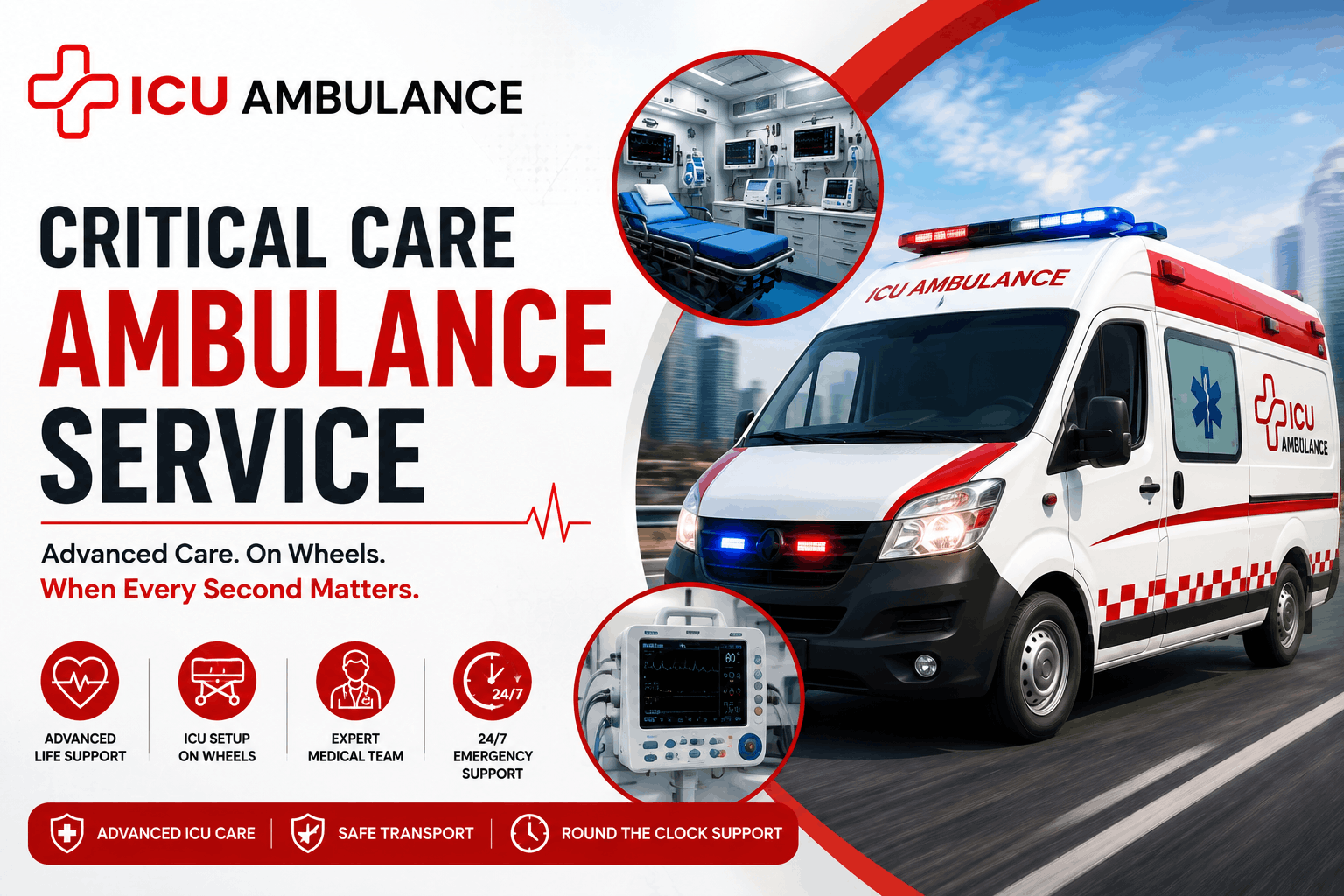
Critical Care Ambulance Service: Complete Guide for Critical Patient Transfer
Transporting a critically ill patient is not the same as transporting a patient who is well. A patient who is critically ill may need continuous medical care, oxygen, medical assistance, and possibly ventilator support during transit. A Critical Care Ambulance Service provides medical care during transit.
An ambulance service that provides critical care transports patients who require a higher level of medical care during transit. The service provides a modified ambulance with a medical team to care for the patient during the transport.
From a medical viewpoint, utilizing a critical care ambulance service helps provide a more organized and safer means of transporting the patient.
What Is a Critical Care Ambulance Service?
A Critical Care Ambulance Service transports patients requiring constant medical supervision and/or support during transit.
A critical care ambulance provides a higher level of service than a patient transport vehicle and is able to carry more sophisticated medical equipment. The level of care provided by the critical care ambulance can be customized based on the patient and the service agreement.
Critical care ambulances are used for:
-
ICU-to-ICU transfers
-
Inter-hospital transfers
-
Patients on ventilators
-
Trauma patients
-
Patients requiring oxygen
-
Cardiac patients
-
Critically ill patients being transferred to a specialised hospital
-
Medically necessary long-distance transfers
The equipment and medical team deployed for the transfer should be aligned to the patient's medical condition and doctor's orders.
Who May Need a Critical Care Ambulance?
Not all patients need to be transported in a fully loaded ambulance. It is about the patient's condition and the kind of care needed during the transport.
A special-case ambulance may be needed if:
1. Requires Ventilator Support
If the patient is unable to breathe sufficiently on their own, they may need a ventilator or assisted breathing during the transport. This kind of patient requires an ambulance that provides respiratory support and observation.
2. Needs Continuous Cardiac Monitoring
If the patient is in a condition that requires continuous ECG and vital sign monitoring during the transport, a cardiac-capable ambulance may be necessary.
3. Is in an Unstable Condition
Patients who have unstable vital signs, breathing difficulties, altered levels of consciousness, or any other condition that may require continuous medical supervision during the transport may be unstable.
4. Is Being Transferred From One Hospital to Another
If the patient needs to be transferred to a hospital that has a specialised doctor/care/unit/procedure, and there are no other options but to transport the patient, a critical care transfer may be required.
5. Requires Oxygen or Other Medical Support
If the patient needs any medical support such as oxygen, suction, infusion, or any other support, the ambulance must have the means and the oxygen supply for the duration of the transport.
Equipment Available in a Critical Care Ambulance
Ambulance categories and providers can differ in the equipment they use. Prior to booking, families should confirm that the vehicle has the necessary equipment for their patient.
Examples of equipment that may be found in an ambulance include:
-
Ventilato
-
Cardiac monitor
-
ECG facility
-
Pulse oximeter
-
Blood pressure monitoring system
-
Suction machine
-
Infusion pumps
-
Syringe pumps
-
Emergency medicines/supplies
-
Stretcher and patient safety restraints
-
Basic emergency resuscitation equipment
For a patient who is ventilator-dependent or highly unstable, the equipment is not able to ensure the safety of the patient during the transfer. The medical team must be able to utilize the equipment and be prepared to intervene if the patient’s condition changes during the transfer.
Medical Staff During Critical Patient Transfer
I always check if a service has staff, but it is especially important if a service has medical personnel.
Depending on the patient and the provider, a transport team may consist of a paramedic, nurse, physician, or another medical professional.
The staffing level is determined by the patient’s diagnosis, the equipment required, and the recommending physician.
For example, a patient who requires mechanical ventilation may need a team that is trained to manage that patient’s airway and ventilator. A patient who requires cardiac monitoring may need a team that is trained in emergency care for the cardiac system.
Prior to confirming a booking, it is important that the ambulance provider understands the patient’s condition.
Critical Care Ambulance vs Normal Ambulance
The main difference is the level of medical support available during transportation.
A normal patient transport ambulance can work for stable patients who mainly need safe transportation between sites. A critical care ambulance can work for patients who may need patient monitoring, advanced equipment, oxygen, or medical intervention during.
So, a standard ambulance will not work for a critically ill patient. The key question will be whether the ambulance has the medical equipment and personnel who are sufficiently trained to work on the patient in question.
How to Book a Critical Care Ambulance
Booking is simpler when you give the full patient information upfront. When calling ICU Ambulance, make sure you have the following details:
Patient Condition
Inform the ambulance team about the patient’s diagnosis, condition, level of consciousness if any, how they are breathing, and other important details about the patient’s condition.
Current Location
The team needs to know the exact location where you want to pick up the patient, what hospital it is, what ward and what level of the ICU it is on, and any other detail that can help them plan the pickup.
Destination
Tell them what hospital you want to transfer the patient to and what city it is in, if it is a long-distance transfer.
Medical Requirements
Tell them if the patient needs a ventilator, oxygen, or any other support.
Doctor’s Instructions
Tell them what kind of ambulance the patient’s doctor recommended.
Transfer Distance
For a long transfer, ask them what oxygen capacity they have, how long it will take, what medical personnel and equipment they will have, and what plans they have for an emergency.
Giving this information reduces the number of questions the ambulance team has and helps them figure out what kind of vehicle is needed.
What Should You Check Before Booking?
Make sure you review these points before you confirm a Critical Care Ambulance Service:
-
Do you have the medical equipment you need?
-
Is the equipment appropriate for the patient?
-
Is there functional equipment and trained staff?
-
Is there enough oxygen for the duration of the transport?
-
Can the ambulance provide for the medical needs of the patient?
-
Is the ambulance capable of doing an inter-facility transfer if needed?
-
Has the ambulance service provider been given a clear picture of the patient’s condition?
-
Have the pick-up and drop-off locations been confirmed?
When it comes to critically ill patients, making sure you have the right service is more important than simply getting the service that is closest to you.
Critical Care Ambulance for Long-Distance Transfers
Planning patient transports over long distances is more involved. You must consider the travel time and the condition of the roads, as well as the patient’s stability and the supplies they may need, including oxygen, as well as any medication they may need. You must also consider whether an emergency may arise during the transport.
When the treating hospital must transfer patient ownership to the receiving hospital, they must share the patient’s records, any medicine the patient is taking, any tests that have been conducted, the patient’s discharge/transfer documents, and any other pertinent information.
Prior to setting out, the transporting ambulance team must be briefed about the patient’s condition and what support the patient may need.
Why Choosing the Right Ambulance Matters
Instability in a patient's condition can occur at any point during transport, and a critically ill patient is no exception. There are several variables that can change, including but not limited to the patient's level of consciousness, their respiratory rate, their blood pressure, their heart rate, their oxygen saturation, etc.
It is beneficial to have an appropriately equipped medical team during transport to observe and manage the patient, but an ambulance should not be mistaken for a treatment facility. The correct service is that which meets the patient's medical needs and maintains the standard of care during the transportation.
Book a Critical Care Ambulance
When specialized medical support is necessary for a patient during transport, consider the patient's condition, the equipment required, the staff, the distance, and the destination in order to arrange the appropriate ambulance.
We at ICU Ambulance understand that every patient is different, and we offer different options for transport based on the medical conditions of the patient. Please provide your patient's condition and transfer details so that we can arrange the most appropriate ambulance for your case.