
Emergency Ambulance vs. ICU Ambulance vs. Basic Ambulance: What's the Difference & When to Call Which?
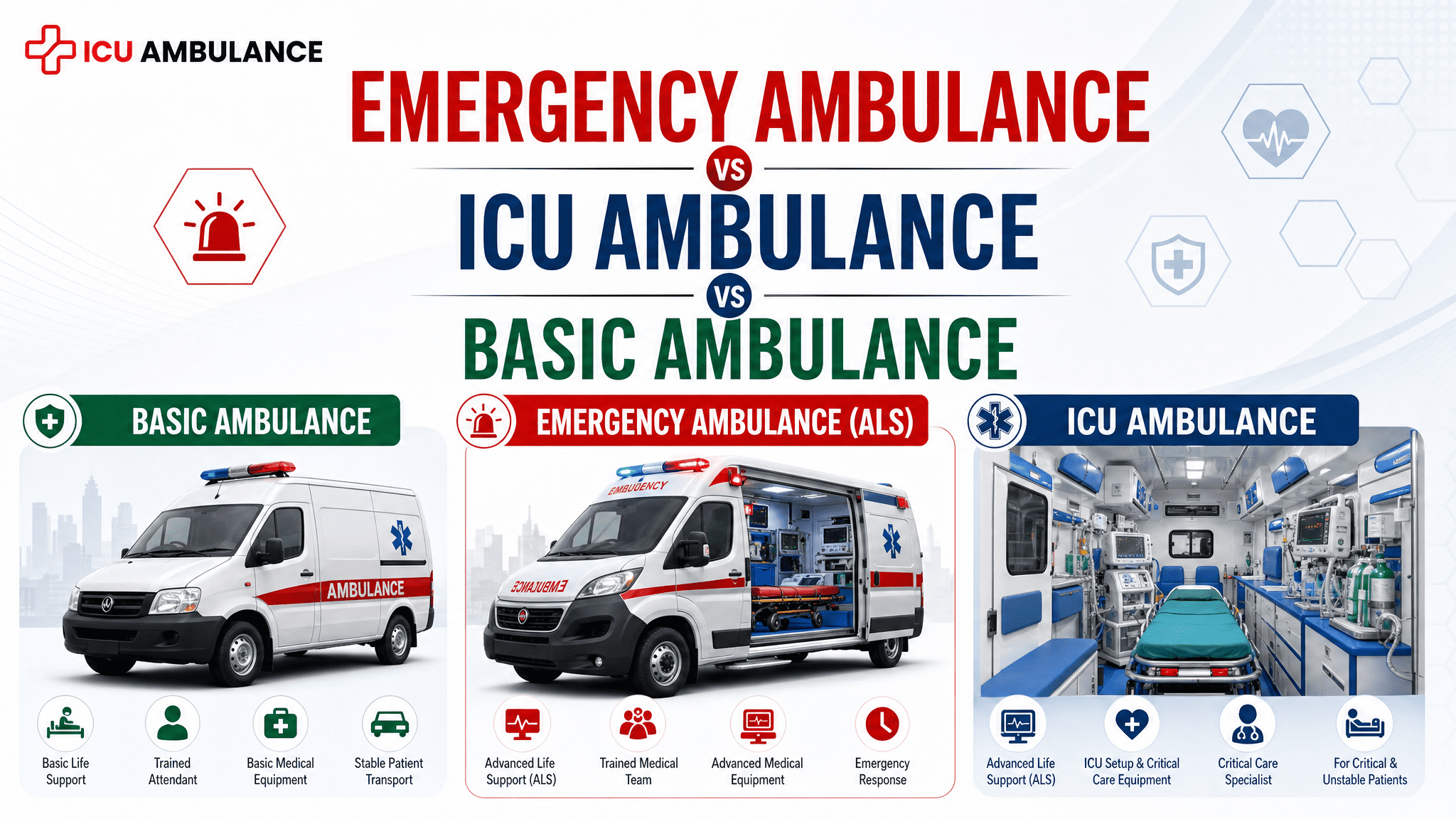
Emergency Ambulance vs. ICU Ambulance vs. Basic Ambulance: What's the Difference & When to Call Which?
Briefly: An emergency ambulance is any ambulance sent out for a medical emergency, but the type of vehicle that arrives depends on the seriousness of the emergency. A basic ambulance takes care of stable patients who require only safe transport. ICU ambulances are fitted with a ventilator, cardiac monitor, and trained medical staff for patients who might deteriorate en route to hospital. Knowing this difference before an emergency occurs can save you precious minutes when it does.
Most people only think about ambulance types the second they are dialling for help, and that is the worst time to be trying to figure it out. This is the kind of confusion that the dispatch team at ICU Ambulance Service Lucknow hears almost daily – a caller is not sure if they need a simple ride to the hospital or full life-support on wheels. This guide takes you through all of it so you can make that decision with confidence. If you want to compare vehicles beforehand, you can always check out our full range of services on our homepage.
What Is an Emergency Ambulance?
The term “emergency ambulance” covers the response to any sudden medical need, be it a traffic collision, a fall, chest pain, difficulty breathing, or sudden fainting. The phrase describes a category of responses. When you call for an emergency ambulance, the dispatcher assesses your description of the patient and selects the most appropriate response unit.
Think of "emergency ambulance" as the umbrella, with basic and advanced units as the two main branches under it. If you've read our earlier guide on what happens when you call an emergency ambulance, you already know that the operator's questions during the call decide which branch gets sent to you.
What Is a Basic Ambulance?
Basic ambulances, or Basic Life Support (BLS) ambulances, are for patients who are stable but still require safe transport with monitoring. It is normally equipped with a stretcher, oxygen support, a first-aid kit, and staff trained in basic patient handling.
For things like: you need a basic ambulance.
-
A small fracture or sprain
-
A patient to be discharged from hospital requiring lying-down transport
-
Mild fever, dehydration, or general weakness
-
Scheduled hospital visits; Patients who cannot sit upright for long
This category is not for a patient whose condition might deteriorate precipitously. That’s where the next one comes in. For a more detailed look at what’s included, see our full basic life support ambulance service.
What Is an ICU Ambulance?
An ICU ambulance is ventilated and equipped like an Intensive Care Unit. It is staffed by paramedics and/or nurses. They are able to provide care and stability to patients during transport that standard EMS personnel are not trained to provide.
Some examples of conditions where ICU ambulance transport is necessary:
-
Patients who have lost consciousness
-
Patients who are having (or have had) a heart attack
-
Patients who are having (or have had) a stroke
-
Patients who have severe breathing difficulties or respiratory failure
-
Patients who require continuous breathing support and/or mechanical ventilation
Patients who require transportation to a higher level of care.
Ventilator ambulances are similar to ICU ambulances. They, too, provide transportation for patients who are ventilator-dependent and who are unable to breathe on their own.
Quick Comparison: Emergency vs ICU vs Basic Ambulance
|
Feature |
Emergency Ambulance |
Basic Ambulance |
ICU Ambulance |
|
Purpose |
General response category |
Stable patient transport |
Critical patient care in transit |
|
Equipment |
Depends on case severity |
Stretcher, oxygen, first aid |
Ventilator, cardiac monitor, defibrillator |
|
Staff |
Varies by dispatch |
Basic trained attendant |
Paramedic/nurse |
|
Best for |
Any urgent call |
Minor injuries, discharge transport |
Heart attack, stroke, unconscious patients |
When Should You Call an Emergency Ambulance?
When you think a situation is beyond your control and getting more critical, don’t think you can handle it on your own. Get help. There are a number of emergencies where you aren’t required to evaluate and diagnose the issue. The dispatcher will determine the right response. Right now, try to be as impartial as you can and give a detailed description of the situation.
When Should You Call a Basic Ambulance?
Select this option for patients who are able to self-transport to and from the hospital. This is the case for the large majority of ambulatory patients, including the following: outpatient surgeries, physical therapy, and other minor injuries and illnesses. Additionally, this includes patients who require transport to the hospital but do not require further medical care or observation on the ambulance.
When Should You Call an ICU Ambulance?
Whenever there is uncertainty about the patient’s condition (i.e., irregular breathing, chest pain, unconsciousness, seizures, or if the patient is dependent on a ventilator), it is always safe to assume the patient needs more than a basic unit. Requesting a basic unit to begin with may lead to a longer wait time and could compromise the patient.
How to Decide Quickly During a Real Emergency
You aren’t expected to study the components of an emergency and what causes a response to become critical during an emergency. That’s why you should call and provide an honest account of your patient. Are they able to communicate? Are they breathing? Are they losing blood? Do they have a pre-existing illness? A qualified dispatcher will quickly pair the right vehicle to your situation better than you could do yourself.
Sometimes, even after you have provided an account of your patient, you may still not know what vehicle you should be calling. In that case, you should definitely ask the dispatcher. The dispatchers at ICU Ambulance Service, Lucknow, for instance, will let you know what is appropriate. It is definitely better that you ask. The worst-case scenario is that you ask what vehicle you should call and you are given the clarification. The worst-case scenario of not giving the information is that the response may not be what you actually want it to be.
Why Choose ICU Ambulance Service Lucknow
For over 10 years, we have been transporting patients in need throughout Lucknow. We have driven patients from emergencies, large and small, in Gomti Nagar, and in accidents and emergency situations near the KGMU and SGPGI. We have various levels of ambulance services. From simple ambulances to more advanced services and critical care units. We train our staff on various levels of medical services. Our staff is medically trained to evaluate various levels of cases to provide care if needed.
You can contact us to get more information regarding our services or to meet our staff. You can call us without delay if you need us. We understand you may not have our number during an emergency, so saving our number during non-emergency situations may be helpful. We hope you never need to call us for an emergency, but if you do, you should know that you can contact us at any time.
A Quick Note Before You Go
This article is for general knowledge to help you in a medical emergency. This article should not be construed as medical advice. If you are currently involved in a medical emergency, this article should not be your primary source of support. Call for help.
Frequently Asked Questions
Is an emergency ambulance the same as an ICU ambulance?
An ICU ambulance is a specific type of emergency ambulance. Basic emergency ambulances respond to and transport patients in an emergency situation.
Can a basic ambulance be upgraded to a critical-care unit during the call?
Yes. If the case is evaluated to be more serious, then a better unit can be diverted to the case.
Which ambulance should I call for a heart attack?
Yes. Heart attacks require medical attention and treatment as quickly as possible.
Does a basic ambulance have any medical staff?
Yes; however, they are not certified as a paramedic or nurse.
Is an ICU ambulance more expensive than a basic one?
Yes. An ICU ambulance has more advanced medical equipment and personnel. For more information, please visit our ambulance charges.
How do I know which service is right for a family member with a chronic illness?
Describe your family member's chronic condition and symptomology to the dispatcher. Generally, if there is a history of cardiac or respiratory conditions, it is best to select the critical care unit, even if the family member appears stable.
These responses are based on real dispatches.
Not Sure Which Ambulance to Call? Talk to Our Team Now — call ICU Ambulance Service Lucknow, visit our homepage to explore all our services, or reach out via our contact page and describe the situation; we'll send the right vehicle immediately.