
Ambulance Booking: Complete Guide to Booking an Ambulance Quickly
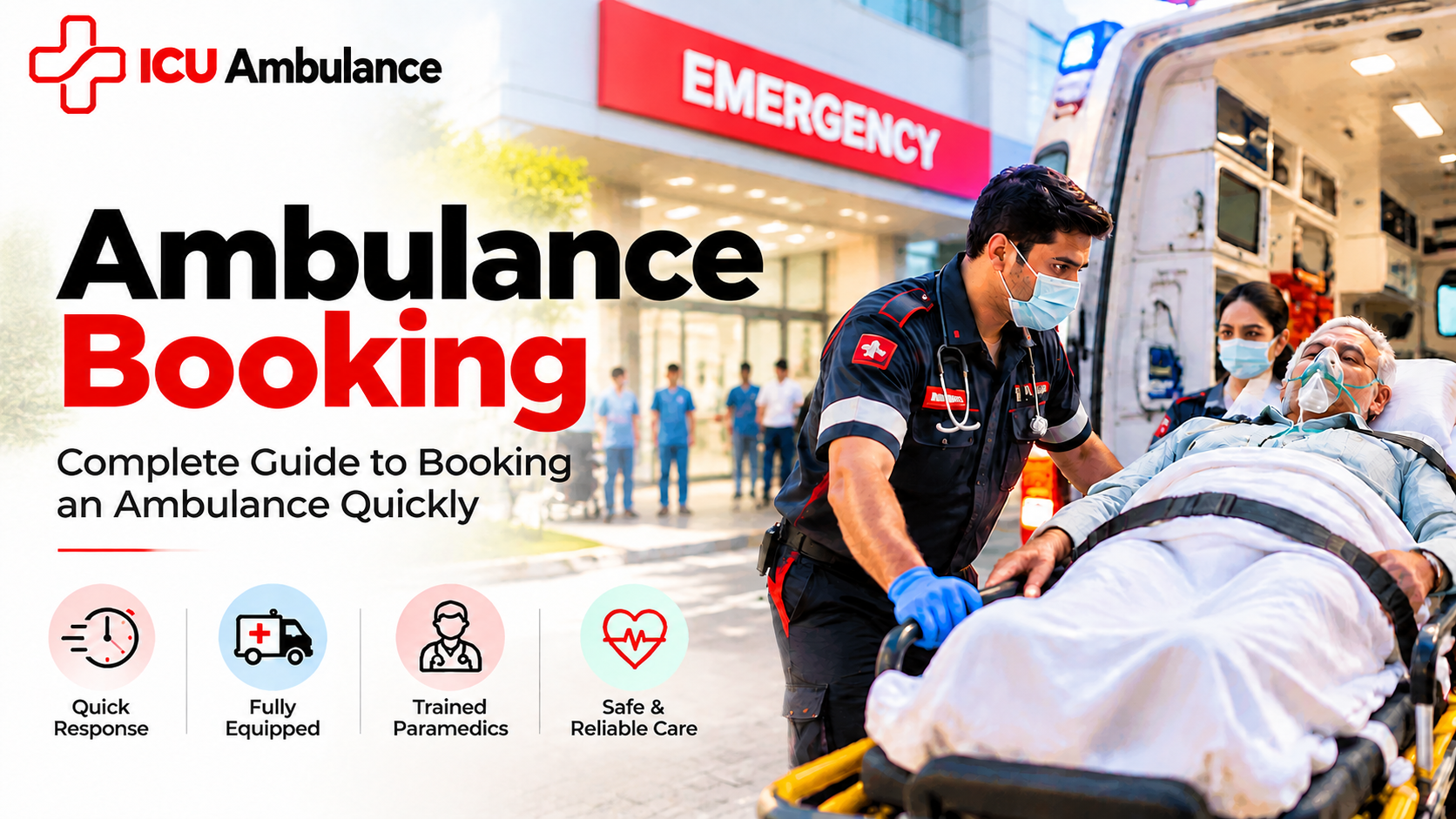
Ambulance Booking: Complete Guide to Booking an Ambulance Quickly
Every moment counts when there is an urgent medical situation. Whether it is an immediate need for hospitalization, a need for planned transport from one hospital to another, or transport over a longer distance, making the correct choice of an ambulance service will make the process easier. Having knowledge about the ambulance booking process before time will ensure that you can make the decision promptly when faced with such a situation.
Ambulances are currently provided to cater to different medical emergencies and different types of transportation needs. Depending on the condition of the patient, the distance of transport, and the type of care required during transit, the best ambulance can be determined. At ICU Ambulance, you can choose from various ambulances.
What Is Ambulance Booking?
Ambulance booking refers to the process of booking a medically qualified transport service for the movement of a patient from one place to another. The patient can be picked up from his or her home, hospital, clinic, accident scene, or any other healthcare facility.
In the course of booking the service, details such as the condition of the patient, pickup place, destination, mobility status, and urgency should be considered. This information is vital for determining the type of ambulance that the patient needs.
If a healthy patient needs to be transported, it could only take an ordinary ambulance, while a critical one would require an ICU ambulance.
When Should You Book an Ambulance?
In some cases, an ambulance may be needed if the patient is unable to travel in his own car or needs any help while being transported. The most common instances include injuries, breathing problems, unconsciousness, weakness, heart problems, post-operative transfer, and critical medical conditions.
In case an immediate transport of the patient with a medical problem is needed, an emergency ambulance should be used. When a patient is medically stable but needs to be transferred from one hospital to another, it can be organized in advance. What really matters is to state the patient's condition while booking.
How to Book an Ambulance Quickly
The procedure becomes easier with the required details already available. These are the steps for booking an ambulance:
1. Share the Exact Pickup Location
Please give the exact pickup address, including a point of reference if possible. If the patient is from an institution such as a large building or hospital, please indicate which floor or ward.
2. Explain the Patient's Condition
Provide information to the dispatcher about what happened and the condition of the patient. Mention critical factors like difficulty breathing, being unconscious, bleeding, chest pain, injury, or inability to move.
3. Provide the Destination
Give the ambulance details of where you want the patient to be taken. For hospital-to-hospital transfers, give the name and address of the hospital.
4. Select the Appropriate Ambulance
The ambulance should meet the needs of the patient. An ordinary patient may not require an advanced ambulance, but a patient who is critical will require a life support ambulance or ICU ambulance.
5. Provide a Contact Number
Provide a working phone number from which the driver/ambulance crew can reach out to the family member while on the way or when searching for the pickup point.
What Information Is Required for Ambulance Booking?
It is good to have the right information available because it will help avoid wastage of time. During ambulance booking, you may be required to provide:
- Age and present condition of the patient
-
Address from where to pick up the patient and any nearby landmarks
-
Name and address of destination hospital or location
-
Reason for transportation
-
Whether the patient walks or not
-
Whether the patient needs oxygen
-
Whether the patient is attached to any medical equipment
-
Phone number of the person accompanying the patient
-
Urgency of the transfer
-
Requirements for long-distance transportation
Be truthful and give correct information regarding the condition of the patient.
Which Type of Ambulance Should You Book?
Not all patients need the same medical assistance. Selecting the appropriate ambulance is one of the most critical decisions.
Basic Ambulance
An ordinary ambulance will be sufficient for patients who require transport but do not need close medical monitoring or life support on the way.
BLS Ambulance
A BLS ambulance offers enhanced basic medical care and is appropriate for those patients who need to be monitored and assisted during transportation.
ALS Ambulance
An ALS ambulance is an ambulance that is meant to cater to those patients who will need some medical assistance on the way. It can have some advanced equipment and medical staff in some cases.
ICU Ambulance
The ICU ambulance is designed to provide care to patients who are critically ill and require constant monitoring and support when being transferred. Equipment can consist of a ventilator, heart monitor, oxygen equipment, infusion pump, suction apparatus, and other emergency medical equipment.
Ventilator Ambulance
A ventilator ambulance can be recommended if the patient is under mechanical ventilation while being transported. There are certain things to consider in transferring the patient.
Ambulance Booking for Emergency and Planned Transfers
Emergency transportation and patient transfer differ in their needs. In an emergency situation, the need is to organize suitable transportation as soon as possible along with accurate patient information. In case of planned transfers, family members can plan patient needs before the journey. This will be helpful if transferring patients from one hospital to another or from hospitals to their residence or from one city to another.
When planning for patient transport services, considerations like travel distance, medical needs, equipment needs, and medical personnel should be taken into account.
Ambulance Booking for Long-Distance Patient Transfer
Transportation over a long distance needs more planning compared to short-distance trips. The family must make the ambulance service aware of the distance, the condition of the patient, the equipment needed, and the destination. In the case of a critically ill patient, there might be a need for constant monitoring during the journey. An ICU ambulance could be more appropriate in this case than normal transport.
Prior to embarking on a long-distance journey, make sure that all necessary arrangements have been made.
What Factors Affect Ambulance Charges?
Charges in an ambulance may differ according to various factors. There is no fixed rate charged for every patient transport. Type of ambulance is one such factor. A simple ambulance will need less input than an ICU or ventilator ambulance. Other factors may include distance, equipment required, staffing requirements, location, time period of journey, and medical condition of the patient.
Hence, it is always advisable to give all information about the journey at the time of booking and then inquire about the charges.
Common Mistakes to Avoid During Ambulance Booking
It might happen that families tend to neglect crucial information while making transportation arrangements amidst stressful circumstances. Do not fail to provide a complete address and do not forget to mention the true condition of the patient. Choosing an ambulance depending on its price is another widespread mistake. The cheapest ambulance does not have to meet the needs of a person who is in need of medical monitoring or any kind of life-supporting devices.
Do not forget to inform about any special conditions – the necessity of having oxygen, ventilation, a stretcher, or difficulties in moving the patient.
Why Choosing the Right Ambulance Matters
Ambulances are not merely a means of transportation; some patients might need medical assistance during transit. A stable patient will need basic assistance, whereas the critically ill patient will need constant monitoring and equipment.
ICU Ambulance concentrates on providing medical transportation in accordance with the needs of the patient. It can be an emergency transport, hospital-to-hospital transport, or long-distance transport. The discussion about the condition of the patient prior to the transport will help find the appropriate ambulance.
Final Thoughts
A proper ambulance booking will assist in organizing the transport process, particularly in cases when the family is under stress. The key steps are providing the necessary patient information, specifying the exact place of pickup and destination, and selecting the ambulance according to the patient's medical condition. In case of an emergency, try not to waste your time and provide detailed information about the patient's condition. If the transfer is planned, then you should take some time to discuss the equipment, staff, distance, and other requirements.
ICU Ambulance tries to help patients and their relatives with proper medical transportation for various kinds of transfers. Proper information and ambulance selection will be helpful for you.
Frequently Asked Questions
How quickly can I book an ambulance?
The duration is dependent on the availability of a proper ambulance, the pick-up point, traffic, and the needs of the patient. Giving full details while booking an ambulance can assist in responding better.
What details should I provide when booking an ambulance?
It is important to mention the age of the patient, their health status, pickup address, destination, phone number, urgency, and need for oxygen, ventilation, or monitoring.
Which ambulance is suitable for a critical patient?
A critically ill patient might need either the ICU ambulance or other advanced ambulances according to their health status. The ambulance services company needs to have information regarding the patient’s health before assigning them any ambulance vehicles.
Can I book an ambulance for hospital-to-hospital transfer?
Certainly. Arrangements can be made for transport from one hospital to another in case of the need to move a patient to another health care institution. It is necessary to consider the degree of medical assistance needed prior to travel.
Can an ambulance be booked for long-distance travel?
Yes. It is possible to arrange for long-distance transport of the patient if the right type of ambulance is available along with all the medical assistance needed. All these things will be discussed while making the booking.
What affects ambulance booking costs?
Fees could be determined by the kind of ambulance, the distance to be covered, the equipment needed, the crew, the distance, and the special needs of the patient.