
Dead Body Ambulance vs Normal Ambulance: What's the Difference?
Dead Body Ambulance vs Normal Ambulance: What's the Difference?
When a family member passes, everything happens very quickly. Hospital staff will have questions, relatives will begin to arrive, and someone will need to make arrangements to transport the body. During all this, a specific mistake is made time and time again. Normal ambulance calls are made instead of dead-body ambulance calls.
There are a lot of reasons this mixing of ambulances happens. For one, most people don't know there are two different types of ambulances for a reason. One is used to transport a patient who is still alive. The other is used to transport a body in a way that is respectful and clean. Our team at ICU Ambulance has over 20 years of experience in both emergency and non-emergency medical transports, and we have seen this confusion a lot, so we have decided to make this guide to explain it once and for all.
In this article, we will explain the difference between the two so that you will know which one to call in a situation where you have to make the call.
What Is a Normal Ambulance?
A patient ambulance is for transporting people who require immediate medical attention and are still alive. These ambulances contain:
-
Oxygen cylinders
-
First aid kits
-
A stretcher that has patient monitoring equipment
-
Ventilators and defibrillators in ICU or ALS ambulances.
The focus in these ambulances is getting the patient to the hospital as quickly as possible with as much medical support as possible. It is not about transporting a deceased body over a long distance and providing as much storage as possible.
What Is a Mortuary Van?
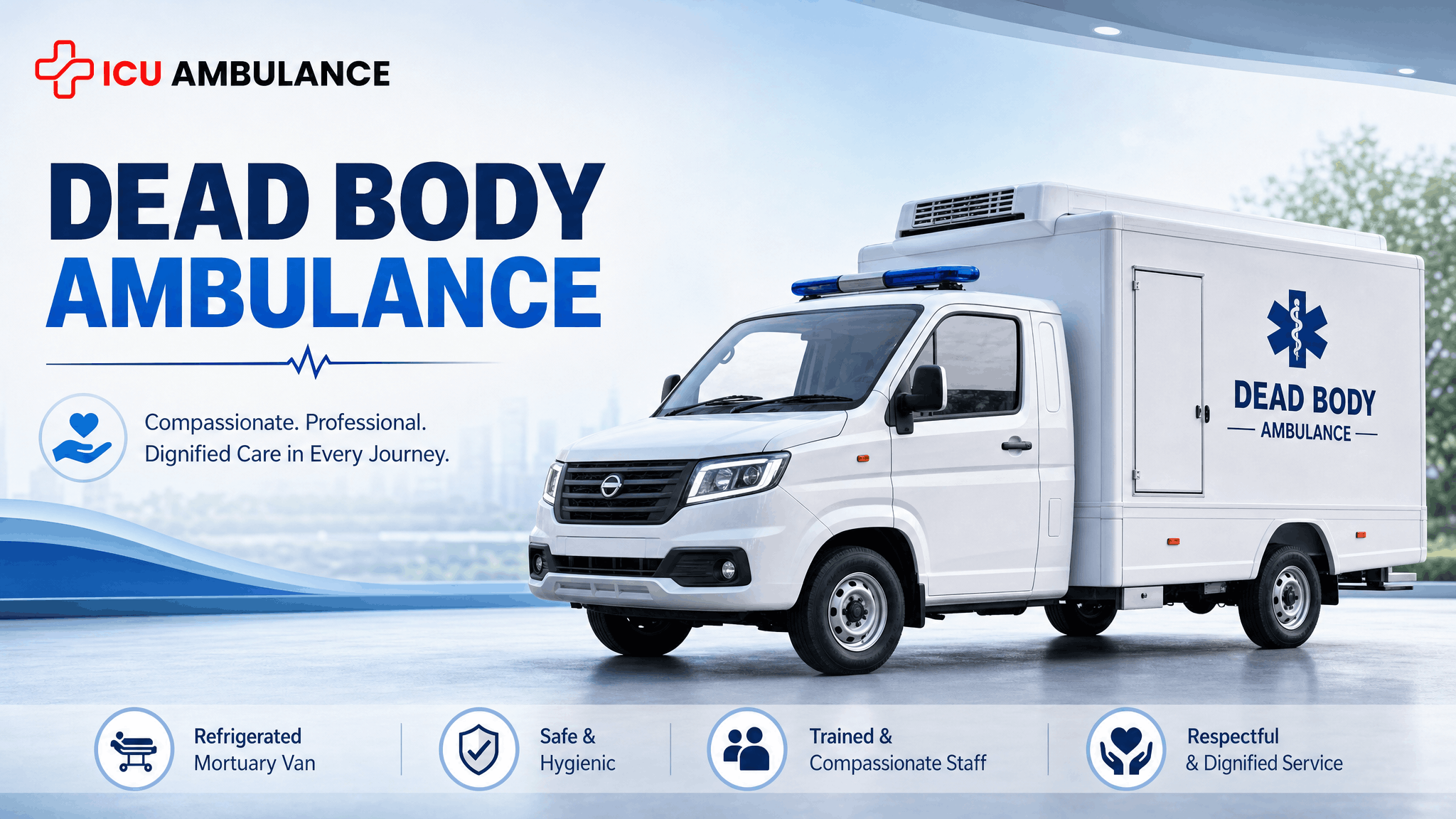
This vehicle is known as a mortuary van because its purpose is to transport the deceased from one location to another, for example, from a hospital to one’s place of residence, or from one city to another for funeral rites.
An ambulance for patient transportation will be equipped with oxygen and other medical supplies for an emergency intervention; however, a van for the transportation of the deceased will not contain any medical supplies because once an individual has passed away, there can be no medical intervention. Instead, consideration for the mortuary van will include:
-
A comfortable, air-conditioned interior
-
Sufficient space to accommodate a stretcher or a coffin
-
A deep freezer unit for long-distance travel
-
Procedures to be carried out to maintain the dignity of the deceased during the transport process
At ICU Ambulance, our mortuary vans are maintained with the same seriousness as our medical fleet, just built for a different purpose.
Key Differences at a Glance
Here is a simple side-by-side comparison to make the choice easier:
|
Feature |
Normal Ambulance |
Dead Body Ambulance |
|
Purpose |
Transport living patients for treatment |
Transport the deceased for last rites or burial |
|
Equipment |
Oxygen, monitors, first aid kit |
Freezer unit, coffin space, disinfectant setup |
|
Staff |
Paramedics, EMTs, sometimes doctors |
Attendants trained in respectful, careful handling |
|
Urgency |
Medical emergency, every second counts |
Time-sensitive, but no medical urgency involved |
|
Interior |
Medical-grade fittings |
Hygienic, freezer-equipped, closed compartment |
|
Documentation |
Patient ID, medical history |
Death certificate, hospital NOC, ID proof |
This table alone shows why one vehicle cannot simply replace the other. A patient ambulance is not built to carry a body safely over long distances, especially in Lucknow's summer heat.
Why Mixing Up the Two Can Cause Real Problems
Some families book the first vehicle available, especially if they are rushing. This creates a lot of issues:
-
No freezer facility: Without a freezer, a body can decay faster during a long journey.
-
Hygiene: A patient ambulance is used for transporting sick patients and treating them. Therefore, using it for something other than that is not good from a hygiene perspective.
-
Legal: There are specific documents for inter-state transfers, and a mortuary van service is aware of all the necessary documents, so using such transport can create legal problems.
-
Dignity: A family that has lost a member deserves a dignified process, not a confusing process because of the wrong vehicle at the wrong time.
There are dedicated services for the deceased to provide those transport services so that the family does not have to go through additional stress at a time when they have lost a family member.
When Do You Need This Type of Service?
You will usually need a mortuary van in the following scenarios:
-
When you need to transfer a body from a hospital to the family’s residence
-
When you need to transport a body to another city or state for a funeral
-
When you need to bring a body back to Lucknow from another location
-
When you need to take a long drive with a body and a deep freezer is necessary to preserve the body
-
When you need to work with the hospital staff to finalize the release and transfer the body
If you have experienced any of the above, then it is appropriate that you have called the appropriate vehicle, which is not a regular patient ambulance.
Documents You Will Likely Need
Most hospitals and transport providers will request a few basic documents before they will release a body for transfer. These documents are:
-
A death certificate issued by the hospital or local municipal body
-
Hospital NOC (No Objection Certificate), if death occurred during treatment
-
ID proof of the deceased and the family member coordinating the transfer
-
Police clearance, only in cases of medico-legal or unnatural deaths
These will save time, especially when there's a lot of distance between you and the destination. If you're unable to think of anything else to say on the call, our guide on what information to give when you book an ambulance has more details.
What to Check Before You Book
Not all providers are the same. When you are considering booking with us, look to see if the provider has:
-
24/7 availability. This need can arise at any hour.
-
A deep freezer option for long-distance transport.
-
Trained and respectful staff. In this moment, staff members' conduct is of great importance.
-
Pricing that is clear and has no hidden fees.
-
Assistance with the paperwork. The family should not have to run around to different offices to get the paperwork themselves.
ICU Ambulance does all of the above, so that your family can focus on the funerary rites.
Final Thoughts
There's more to selecting a vehicle between a normal ambulance and a mortuary van. It's about providing your loved one with a secure, respectful, and swift last journey. The next time you find yourself in this situation, don't hesitate or assume which vehicle you should call.
If you are having trouble identifying the right vehicle for your situation, give ICU Ambulance a call; we are available 24/7.